

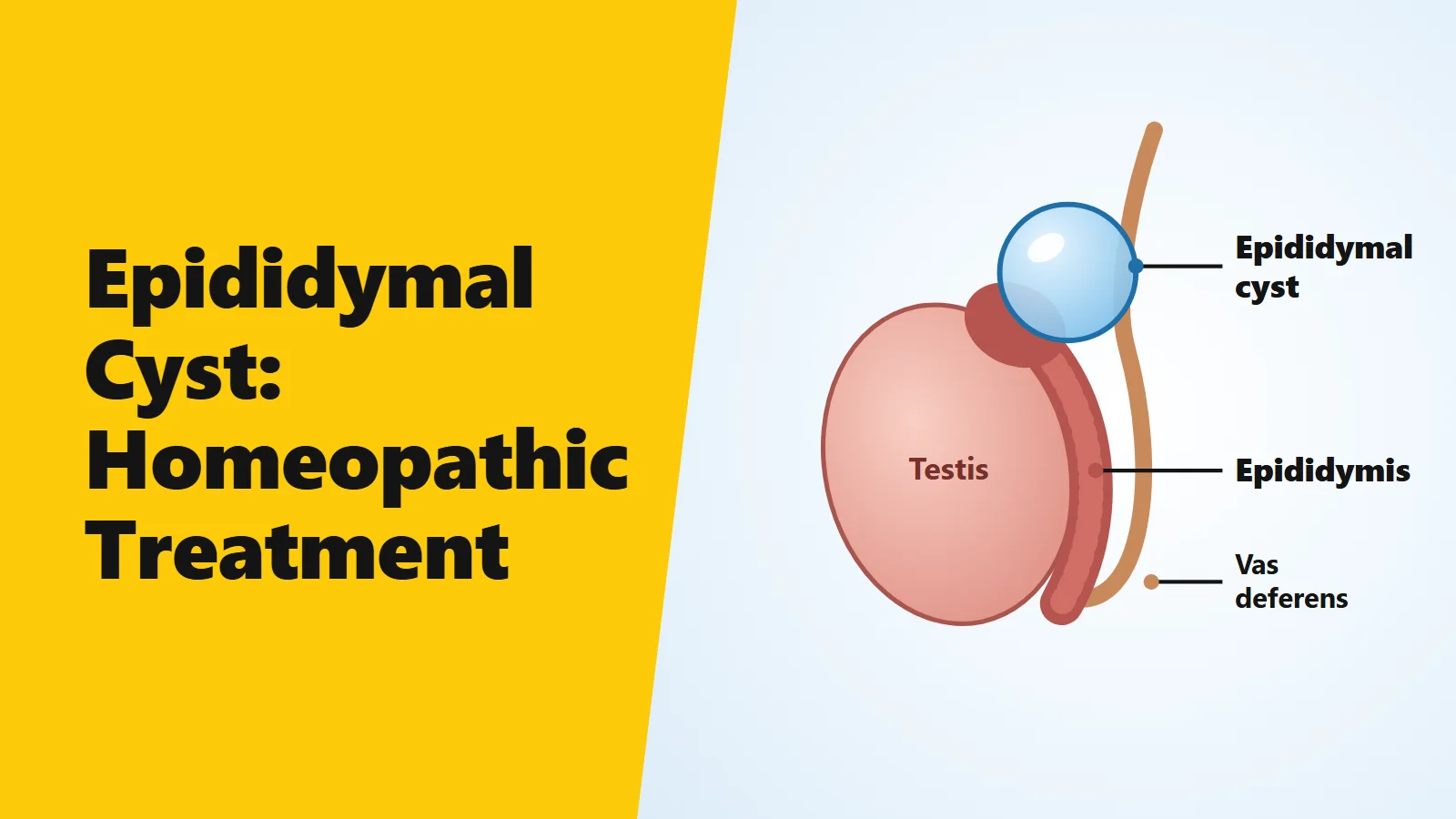
Finding a small, smooth lump above or behind the testicle can be worrying. In most men it turns out to be an epididymal cyst, a harmless fluid-filled sac in the coiled tube that stores sperm. Because it is benign, many doctors simply advise “wait and watch”, while surgery is kept for large or painful cysts. This guide explains what an epididymal cyst is, how it differs from a spermatocele, hydrocele, varicocele or testicular tumour, how it is diagnosed, what conventional treatment offers, and how epididymal cyst homeopathic treatment is planned as a non-surgical option. If you cannot visit a clinic, online homeopathic treatment for epididymal cyst is also possible, and the condition is managed as part of our men’s health homeopathy care.
What is an epididymal cyst?
The epididymis is a tightly coiled tube, about six metres long when uncoiled, that sits on the upper and back part of each testicle. Sperm made in the testicle mature and are stored here before ejaculation. It has three parts: the head (caput) at the top, the body, and the tail (cauda), which continues as the vas deferens.
An epididymal cyst is a smooth, round sac filled with clear fluid that grows from the epididymis, most often from its head. It is separate from the testicle itself, which is why it is felt as a “pea” or “extra ball” sitting above or behind the testis. Epididymal cysts are very common: ultrasound studies find them in roughly 20–40% of men who are scanned for other reasons, and they become more frequent with age. They are almost always benign (non-cancerous).
Epididymal cyst vs spermatocele
A spermatocele (also called a seminal cyst) is a similar cyst that contains sperm and looks milky when the fluid is drawn out. An epididymal cyst contains clear fluid without sperm. On examination and ultrasound the two look almost identical, they behave the same way, and they are treated the same way, so the terms are often used interchangeably.
Causes and risk factors
The exact cause is often not known. The most widely accepted explanation is a partial blockage of the small ducts of the epididymis. Fluid and sperm that cannot drain build up behind the block and slowly stretch the duct into a cyst. Factors linked with epididymal cysts include:
- Age: most common between 20 and 50 years and increasingly frequent after 40
- Past inflammation or infection of the epididymis (epididymitis), including sexually transmitted infections
- Injury to the scrotum or groin
- Previous surgery in the area, such as vasectomy or hernia repair
- Developmental factors: remnants of embryonic ducts can form small cysts, and maternal exposure to diethylstilbestrol (DES) has been linked with them
- Genetic conditions such as von Hippel–Lindau disease and cystic fibrosis, where cysts may be multiple or on both sides
Epididymal cysts are not caused by masturbation, sexual activity or lifting weights, and they are not contagious.
Epididymal cyst symptoms
Small cysts usually cause no symptoms and are found by chance, during self-examination or on a scan done for another reason. When symptoms do occur, they include:
- A smooth, round, soft or firm lump above or behind the testicle, usually painless
- A lump that can be felt as separate from the testis and that may move slightly under the fingers
- A feeling of heaviness or dragging in the scrotum when the cyst is large
- Dull ache or discomfort, especially after long standing, walking, cycling or exercise
- Discomfort during or after intercourse in some men
- Visible enlargement of one side of the scrotum with very large cysts
- One or several cysts, on one or both sides
Sudden, severe pain is not typical of an epididymal cyst and needs urgent assessment (see warning signs).
Epididymal cyst vs other scrotal lumps
Any new lump in the scrotum should be checked by a doctor, because a few scrotal swellings need prompt treatment. The table below shows how an epididymal cyst usually differs from other common causes.
| Condition | Where it is felt | Typical features | Urgency |
|---|---|---|---|
| Epididymal cyst / spermatocele | Above or behind the testis, separate from it | Smooth, round, usually painless; glows when a torch is held behind it (transillumination) | Routine check |
| Hydrocele | Surrounds the whole testis | Soft, painless swelling; testis is hard to feel separately; transilluminates | Routine check |
| Varicocele | Above the testis, usually the left side | Feels like a “bag of worms”; larger on standing; dull ache; may affect fertility | Routine check |
| Epididymitis | Behind the testis | Painful, tender, swollen, often with fever or burning urine | See a doctor soon |
| Inguinal hernia | From the groin down into the scrotum | Increases on coughing or straining; may go back when lying down | See a doctor; urgent if painful and stuck |
| Testicular torsion | The testis itself | Sudden severe pain, swelling, nausea, testis may sit high | Emergency, within hours |
| Testicular tumour | Within the testis | Hard, often painless lump that is part of the testis; does not transilluminate | See a doctor promptly |
How an epididymal cyst is diagnosed
Diagnosis begins with a history and a gentle examination of the scrotum, usually standing and lying down. A doctor checks whether the lump is separate from the testis, whether it is tender, and whether light from a small torch passes through it (transillumination), which suggests a fluid-filled cyst.
- Scrotal ultrasound (USG scrotum with Doppler) is the key test. It confirms a thin-walled, fluid-filled cyst in the epididymis, measures its size, and, most importantly, shows that the testis itself is normal. Doppler also checks blood flow and helps rule out varicocele or torsion.
- Urine tests are advised if there is pain, burning urine or discharge, to look for infection.
- Semen analysis may be suggested if cysts are on both sides or if a couple is trying to conceive.
- Tumour markers or further imaging are only needed when the ultrasound shows something within the testis rather than a simple cyst.
Keeping your ultrasound reports is useful: repeat scans at intervals give an objective record of whether the cyst is stable, growing or shrinking during any treatment.
Conventional treatment options
- Watchful waiting: small, painless cysts are usually left alone and checked periodically. Many stay the same size for years, and a few shrink on their own.
- Pain relief and support: simple painkillers and supportive underwear for mild aching.
- Aspiration or sclerotherapy: drawing out the fluid with a needle, sometimes followed by injecting a sclerosing agent. It is quick, but cysts frequently refill and it carries a small risk of infection.
- Surgical removal (spermatocelectomy or epididymal cyst excision): advised for large, painful or rapidly growing cysts. Surgery is usually effective, but possible effects include swelling, bruising, infection, chronic scrotal pain, recurrence and, because the epididymis carries sperm, a risk of blockage that may reduce fertility on that side. For this reason surgeons are often cautious about operating on young men who still plan to have children.
Since most cysts are harmless and surgery has its own risks, many men look for a gentle approach that can ease symptoms and limit growth without an operation.
How epididymal cyst homeopathic treatment works
Homeopathy does not treat the cyst as an isolated lump. It looks at the person as a whole and the tendency behind the problem, for example past epididymitis, a tendency to form cysts or nodules elsewhere, injury, or a general constitutional state. The aims of homeopathy for epididymal cyst are to:
- Relieve heaviness, dragging pain and discomfort in the scrotum
- Stop or slow further growth of the cyst and reduce the chance of new cysts
- Support gradual reduction in size where possible, checked by repeat ultrasound
- Address associated complaints such as recurrent urinary infection, prostatitis or anxiety about the lump
- Offer an epididymal cyst treatment without surgery for suitable cases, while referring for surgery when it is genuinely needed
The prescription is individualised and is based on:
- Local findings: side, size, number of cysts, consistency, tenderness and ultrasound report
- Type of pain: dragging, drawing, pressing or shooting; better or worse with heat, cold, movement or support
- History: injury, infection, sexually transmitted disease, vasectomy, hernia surgery or long-term illness
- General constitution: sensitivity to heat or cold, appetite, thirst, sleep, perspiration and energy
- Mind and emotions: anxiety, stress and temperament
Homeopathic medicines commonly considered for epididymal cyst
The homeopathic medicines for epididymal cyst below are among those described in the materia medica for complaints of the testis, epididymis and spermatic cord. They are listed to show how individualisation works, not as a self-treatment list.
Rhododendron chrysanthum
Swelling and hardness of the epididymis and testis, with drawing pains that are clearly worse before storms and in cold, damp weather. Often considered when the testis feels bruised or “crushed”.
Clematis erecta
Indurated, swollen epididymis or testis, usually on the right side, with pains extending along the spermatic cord, especially after past inflammation or suppressed discharge.
Pulsatilla nigricans
Swelling of the epididymis after epididymitis or injury, with drawing pains along the cord, a mild, changeable temperament, little thirst and a clear preference for open air.
Conium maculatum
Slow-growing, hard, painless swellings and nodules, often in older men or after injury, with a general tendency to glandular hardening.
Spongia tosta
Swollen, sensitive testis or cord with squeezing pains, considered especially when there is a background of glandular swelling.
Other medicines in the materia medica
Depending on the case, Aurum metallicum, Silicea, Thuja occidentalis, Calcarea fluorica, Apis mellifica, Arnica montana (after injury) or a deep-acting constitutional medicine may be considered.
Please do not self-medicate. A new scrotal lump must first be examined and confirmed by ultrasound, because a testicular tumour or torsion can feel similar to an untrained hand. Choosing the right medicine, potency and follow-up needs a qualified homeopathic physician.
What does the scientific evidence say?
An honest picture matters. There are no large, well-designed clinical trials of homeopathy specifically for epididymal cysts or spermatoceles, so there is no strong scientific proof that homeopathic medicines shrink these cysts. The evidence for homeopathy in general is debated, and major reviews, including the 2015 report of Australia’s National Health and Medical Research Council, did not find reliable evidence that it works better than placebo across conditions. Reports of benefit in cysts come mainly from clinical experience and case reports.
What is well established is the natural history of the condition: most epididymal cysts are benign, many stay stable, and some shrink without any treatment. This is why, in our practice, we judge progress objectively with repeat scrotal ultrasound and symptom records rather than by feel alone, and we advise surgical opinion when a cyst keeps enlarging, causes significant pain, or when there is any doubt about the diagnosis.
How long does treatment take?
Duration depends on the size and number of cysts, how long they have been present, and general health. As a general guide from clinical experience:
- First 4–6 weeks: heaviness, dragging and aching often begin to ease.
- 3 months: a repeat ultrasound is usually done to compare size with the first report.
- 4–8 months or longer: treatment may continue for larger, multiple or long-standing cysts, with periodic scans.
Results vary from person to person. Very large cysts, or cysts causing severe pain, may still need surgical treatment.
Self-care and lifestyle tips
- Wear supportive underwear (briefs or a scrotal support) to reduce dragging and aching.
- Do a monthly testicular self-examination after a warm bath, and note any change in size or feel.
- Use a cold compress wrapped in cloth for 10–15 minutes if the area aches after activity.
- Avoid prolonged cycling or heavy straining if they worsen discomfort.
- Treat urinary and genital infections early and practise safe sex to reduce epididymitis.
- Do not try to squeeze or drain the cyst yourself.
- Keep all ultrasound reports together so changes can be compared.
Warning signs: see a doctor promptly
Most epididymal cysts are harmless, but please seek medical help urgently if you notice:
- Sudden, severe pain in the testis or scrotum, with or without vomiting (possible torsion, an emergency)
- A hard lump within the testis itself, rather than beside it
- Rapid growth of a lump over a few weeks
- Redness, warmth, fever or burning urine with scrotal pain (possible infection)
- A swelling in the groin that increases on coughing and becomes painful and stuck
- Unexplained weight loss, back pain or breast tenderness along with a scrotal lump
Our article on symptoms that need urgent care explains more.
Online homeopathic treatment for epididymal cyst
Many men feel shy discussing a scrotal lump face to face, and many live far from a clinic. Online homeopathic treatment makes private, convenient care possible. At Paras Homeopathy, an online homeopathy consultation for epididymal cyst works like this:
- Book a video or phone appointment and share your scrotal ultrasound and any other reports securely.
- Detailed case taking by Dr. Ramdeo Lamoria: symptoms, history, constitution and lifestyle.
- Individualised medicines are prescribed and couriered to your home anywhere in India or abroad.
- Follow-ups every 4–6 weeks, with a repeat ultrasound at suitable intervals to track the cyst objectively.
If an in-person examination is needed, or anything in your report suggests a problem other than a simple cyst, you will be advised to see a local doctor or urologist without delay.
Consulting Paras Homeopathy
At Paras Homeopathy, Dr. Ramdeo Lamoria (BHMS, 22+ years of clinical experience) treats epididymal cyst, spermatocele, hydrocele, varicocele and related complaints as part of our men’s health and urinary and kidney care services. The first consultation includes a detailed case history, a review of ultrasound and other reports, and a written follow-up plan.
You can visit the clinic in Sardarpura, Jodhpur, or consult online from anywhere in India or abroad, with medicines delivered to your door. Book an appointment to discuss your case.
Before your visit, you can read patient reviews and get directions on our Google Business Profile (open in Google Maps). Dr. Lamoria also explains common conditions in short videos on the Paras Homeopathy YouTube channel.
Frequently asked questions
Can homeopathy cure an epididymal cyst without surgery?
Homeopathic treatment aims to relieve pain and heaviness, stop further growth and support gradual reduction of the cyst without surgery, and many patients report symptom relief. There is no strong clinical-trial evidence that homeopathy dissolves cysts, so progress should be checked with repeat ultrasound. Very large or painful cysts may still need surgery.
Is an epididymal cyst dangerous or cancerous?
No. An epididymal cyst is a benign, fluid-filled sac and does not turn into cancer. However, any new scrotal lump should be confirmed by ultrasound, because a testicular tumour is a different condition that needs prompt treatment.
Which is the best homeopathic medicine for epididymal cyst?
There is no single best medicine for everyone. Medicines such as Rhododendron, Clematis erecta, Pulsatilla, Conium and Spongia are commonly considered, but the choice depends on the cyst, the type of pain, the history and the person’s overall constitution, so it should be made by a qualified homeopathic physician.
Does an epididymal cyst affect fertility?
Most epididymal cysts do not affect fertility or sexual function. Fertility may be affected if there are large cysts on both sides, or after surgical removal, which can block the sperm passage on that side. A semen analysis can be done if you are planning a family.
Can an epididymal cyst go away on its own?
Some small cysts shrink or disappear without treatment, but many stay the same size for years and a few slowly enlarge. Regular self-examination and periodic ultrasound help track any change.
What size of epididymal cyst needs treatment?
Size alone does not decide treatment. Cysts under about 1 cm that cause no symptoms are usually just observed. Treatment is considered when a cyst causes pain, heaviness or discomfort, keeps growing, or becomes large enough to be bothersome, whatever its exact size.
How long does homeopathic treatment for epididymal cyst take?
Discomfort often eases within 4–6 weeks. Changes in size are judged on a repeat ultrasound, usually after about three months, and treatment may continue for 4–8 months or longer for large, multiple or long-standing cysts.
Can I get online homeopathic treatment for epididymal cyst?
Yes. You can consult Dr. Ramdeo Lamoria by video or phone from anywhere in India or abroad. Your scrotal ultrasound report is reviewed during the online consultation, medicines are couriered to your home, and follow-ups are done online.
Key takeaways
- An epididymal cyst is a common, benign, fluid-filled sac above or behind the testis; a spermatocele is a similar cyst containing sperm.
- Scrotal ultrasound confirms the diagnosis and rules out more serious causes of a lump.
- Small, painless cysts are usually observed; surgery is reserved for large or painful ones and can affect fertility on that side.
- Epididymal cyst homeopathic treatment is individualised and aims to relieve symptoms and limit growth without surgery, with progress checked by repeat ultrasound.
- Sudden severe pain or a hard lump within the testis needs urgent medical attention.
- Online homeopathic treatment allows private consultation and home delivery of medicines across India and abroad.
Related reading
- How to consult a homeopathic doctor online in India
- Online homeopathic consultation in India and worldwide
- Homeopathy online consultation with a homeopathic doctor
- How online homeopathic treatment works
- Homeopathic treatment for men’s health problems
- Homeopathy for urinary and kidney conditions
- Homeopathic treatment for genital warts (HPV)
- Preparing for your homeopathic consultation